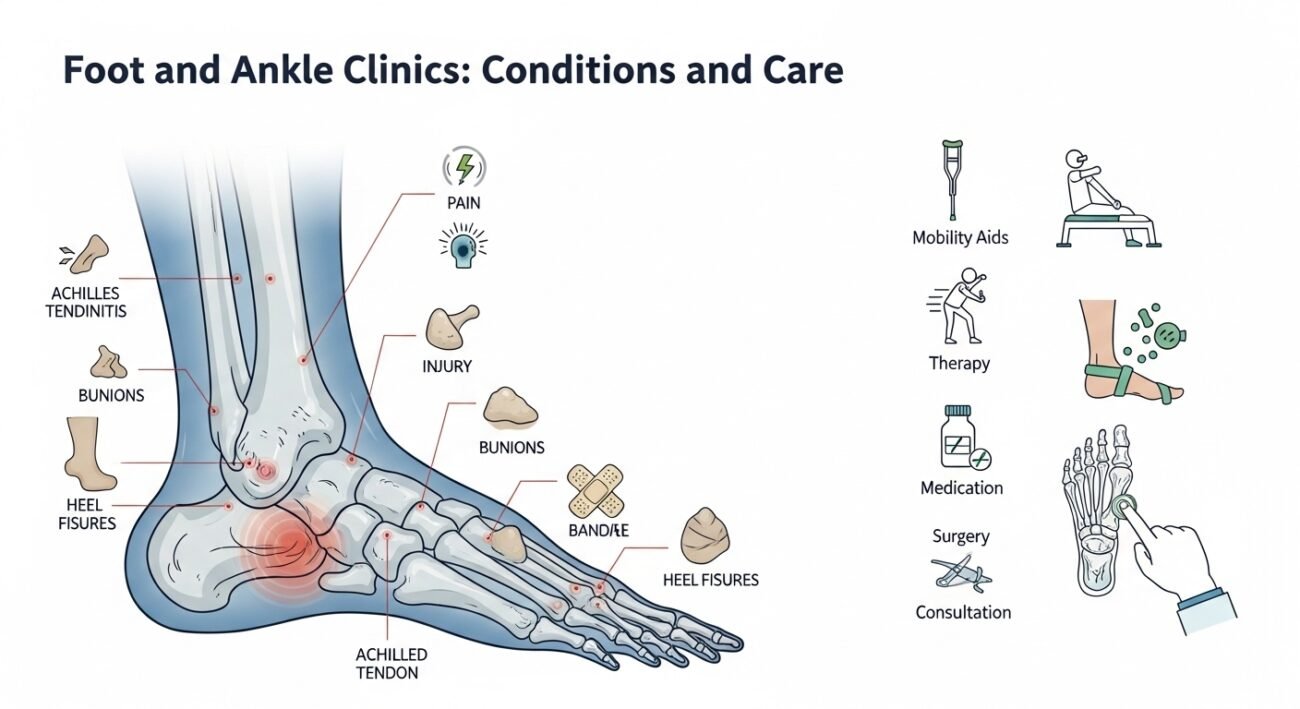
The foot and ankle form the foundation of all upright activity — supporting the full body weight through every step, run, and jump. Foot and ankle conditions are remarkably common: plantar fasciitis is one of the leading causes of heel pain, affecting 10% of the population; ankle sprains are the most common sports injury; and diabetic foot disease is the leading cause of non-traumatic limb amputation. Podiatry and orthopedic foot/ankle clinics provide specialized care for the full spectrum of foot and ankle conditions. This guide explains common conditions and their clinical management.
Common Foot and Ankle Conditions
Plantar Fasciitis
The most common cause of heel pain — inflammation of the plantar fascia (the thick band connecting heel to toes). Classic presentation is sharp heel pain with the first steps in the morning. Treatment includes calf and plantar fascia stretching, supportive footwear, custom orthotics, physical therapy, and corticosteroid injections. The vast majority resolves with conservative management over 6–12 months.
Ankle Sprains
Lateral ankle sprains (inversion injuries to the ATFL and CFL ligaments) are the most common sports injury. RICE protocol (rest, ice, compression, elevation) in the acute phase, followed by progressive rehabilitation focusing on peroneal strengthening and proprioception training to prevent recurrence. Severe sprains with instability or suspicion of fracture require X-ray evaluation.
Bunions (Hallux Valgus)
Lateral deviation of the great toe causing prominence at the first metatarsophalangeal joint. Conservative management includes wide-toe-box footwear, orthotics, and padding. Severe symptomatic bunions unresponsive to conservative measures are surgically corrected.
Diabetic Foot Care
People with diabetes require specialized foot surveillance — regular podiatry visits for nail care, callus management, and early identification of ulcers. Education about daily self-examination, proper footwear, and prompt attention to any foot wound is essential. Even minor foot injuries in diabetic patients can progress to serious infection and amputation risk without proper management.
Conclusion
Foot and ankle conditions significantly affect mobility and quality of life — yet they are frequently undertreated. Regular podiatry care for high-risk patients (diabetics, those with foot deformities), prompt evaluation of acute injuries, and physical therapy for chronic conditions provide the management that keeps people on their feet and active.
FAQs – Foot and Ankle Clinics
Q1. Should I see a podiatrist or an orthopedic surgeon for foot pain?
A: Podiatrists are specialists in foot and ankle conditions who manage both medical and surgical foot care. Orthopedic foot and ankle surgeons may be preferred for complex reconstructive surgery. Either specialist provides appropriate initial evaluation for most foot and ankle complaints.
Q2. What is Morton’s neuroma?
A: A thickening of the nerve tissue between the third and fourth metatarsal bones, causing pain, numbness, and tingling in the ball of the foot and toes. Treatment includes wide-toe-box footwear, metatarsal pads, corticosteroid injections, and surgical excision for refractory cases.
Q3. Can flat feet cause pain?
A: Yes. Flexible flat feet are often asymptomatic; painful flat feet (adult-acquired flatfoot from posterior tibial tendon dysfunction) require specific management with supportive footwear, orthotics, physical therapy, and in severe cases, surgical reconstruction.
Q4. What is the best treatment for Achilles tendinopathy?
A: Eccentric heel drop exercises — a specific physical therapy protocol shown to be the most effective treatment for Achilles tendinopathy — involve lowering the heel below the level of a step from a calf-raised position. Performed consistently over 12 weeks, this protocol resolves the majority of Achilles tendinopathy cases.
Q5. How often should diabetic patients see a podiatrist?
A: Diabetic patients without current foot complications should see a podiatrist annually. Those with neuropathy, peripheral artery disease, history of foot ulcers, or structural deformities may need more frequent visits — every 1–3 months — for preventive foot care and surveillance.
